
A car accident can disrupt your life in an instant. Even a relatively minor collision can leave you dealing with injuries, medical appointments, insurance adjusters, vehicle repairs, and financial uncertainty. Knowing what to do immediately after a crash can help protect both your health and your ability to pursue compensation if another driver caused the accident.
Taking the right steps can make a significant difference in the outcome of your claim.
Prioritize Your Safety

Your first priority should always be safety.
If possible:
- Move your vehicle out of traffic if it is safe to do so.
- Turn on your hazard lights.
- Check yourself and your passengers for injuries.
- Avoid standing in active traffic lanes.
- Wait in a safe location until emergency responders arrive.
Do not leave the scene of the accident immediately following a crash unless emergency medical treatment requires transportation to a hospital.
Call 911
Even if the accident appears minor, contact law enforcement.
A responding officer can:
- Secure the accident scene
- Assist injured parties
- Interview drivers and witnesses
- Document roadway conditions
- Prepare an official accident report
The police report often becomes an important piece of evidence during an insurance claim. While it may not determine fault by itself, it can provide valuable information about the circumstances surrounding the collision.
If emergency medical services arrive, allow them to evaluate your condition.
Seek Medical Attention Immediately
Many injuries are not immediately obvious after a collision.
The adrenaline released during an accident can temporarily mask symptoms of serious injuries, such as:
- Concussions
- Whiplash
- Soft tissue injuries
- Internal bleeding
- Back injuries
- Neck injuries
Even if you believe you feel fine, visit an emergency room, urgent care center, or your primary care physician as soon as possible.
Prompt medical treatment helps:
- Protect your health
- Create medical documentation
- Connect your injuries to the accident
- Prevent insurance companies from arguing that your injuries occurred elsewhere
Follow all treatment recommendations and attend every follow-up appointment.
Exchange Information with the Other Driver
It is crucial to exchange certain information following an accident.
Obtain:
- Full name
- Address
- Phone number
- Driver’s license number
- Insurance company
- Insurance policy number
Remain polite during the exchange.
Avoid discussing fault or apologizing for the accident, even if you believe you may have contributed in some way. Statements made at the scene can later be misunderstood or used against you during the claims process.
Document the Accident Scene
If you are physically able, gather as much evidence as possible before leaving the scene.
Take photographs of:
- Vehicle damage
- License plates
- Skid marks
- Debris
- Road conditions
- Traffic signs and signals
- Weather conditions
- Visible injuries
The more documentation you collect immediately after the collision, the easier it may be to establish what happened later.
Gather Witness Information
Independent witnesses often provide valuable evidence.
If anyone witnessed the collision, ask for:
- Their name
- Phone number
- Email address
Witness testimony can help clarify how the accident occurred if the drivers provide conflicting accounts.
Notify Your Insurance Company
Many insurance policies require drivers to report accidents within a reasonable amount of time.
Provide basic factual information, including:
- Date and time of the accident
- Location
- Vehicles involved
- Police report number, if available
Keep your statements brief and accurate.
Be Careful What You Say
Following an accident, insurance adjusters may ask questions designed to limit their company’s liability.
Avoid statements such as:
- “I’m fine.”
- “I wasn’t hurt.”
- “The accident was my fault.”
- “I didn’t see the other vehicle.”
Instead, simply explain that the accident is still being investigated and that you are continuing to receive medical evaluation if applicable.
Preserve Important Evidence
Evidence can disappear quickly after a car accident.
Keep copies of:
- Medical records
- Medical bills
- Prescription receipts
- Physical therapy records
- Repair estimates
- Vehicle repair invoices
- Rental car expenses
- Photographs
- Communications with the insurance company
- Wage loss documentation
These records can help demonstrate the extent of your injuries and losses.
Continue Following Your Medical Treatment Plan
Insurance companies often review medical records closely.
Stopping treatment too early or missing appointments may allow insurers to argue that:
- Your injuries were not serious.
- You recovered quickly.
- Your current symptoms are unrelated to the accident.
Continue attending appointments until your healthcare provider determines that you have reached maximum medical improvement or completed your treatment plan.
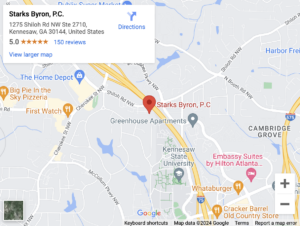
Contact the Kennesaw Car Accident Attorneys at Starks Byron, P.C. to Schedule a Free Consultation
After a serious collision, handling insurance companies while recovering from injuries can be overwhelming. An experienced attorney can investigate the accident, preserve evidence, communicate with insurers, calculate your damages, negotiate for a fair settlement, and, if necessary, pursue your claim through litigation.
If you were injured in a car accident in Kennesaw, Starks Byron, P.C. can evaluate your case, explain your legal options, and help you pursue just compensation. Contact us today at (404) 795 5115 for a free consultation with an experienced Kennesaw car accident attorney.